

$400m Machine vs. $200 Toy
There is a machine in the Netherlands that is essentially the heartbeat of the modern world. It’s called an Extreme Ultraviolet (EUV) lithography tool, and it’s built by ASML.
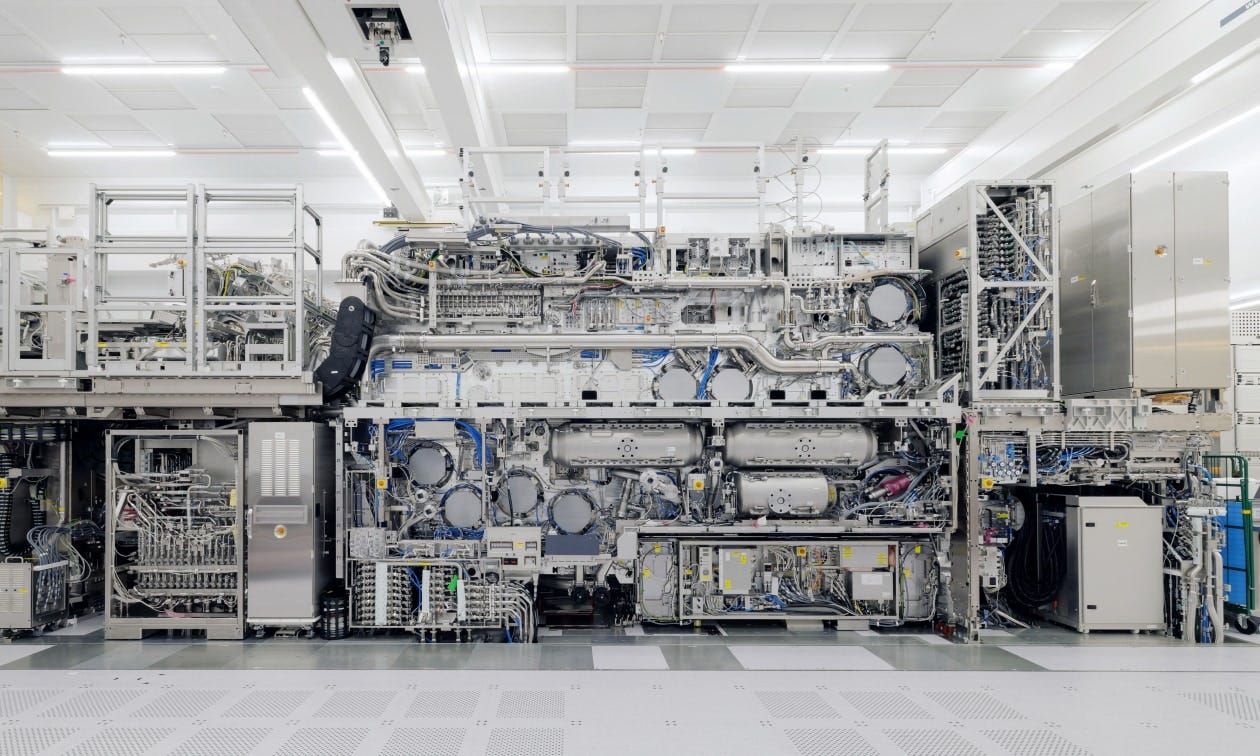
Without these machines, we don’t have the high-end chips that power your iPhone, your AI models, or your data centers. Each unit costs roughly $400 million, has 100,000+ parts, and requires three Boeing 747s just to deliver it.
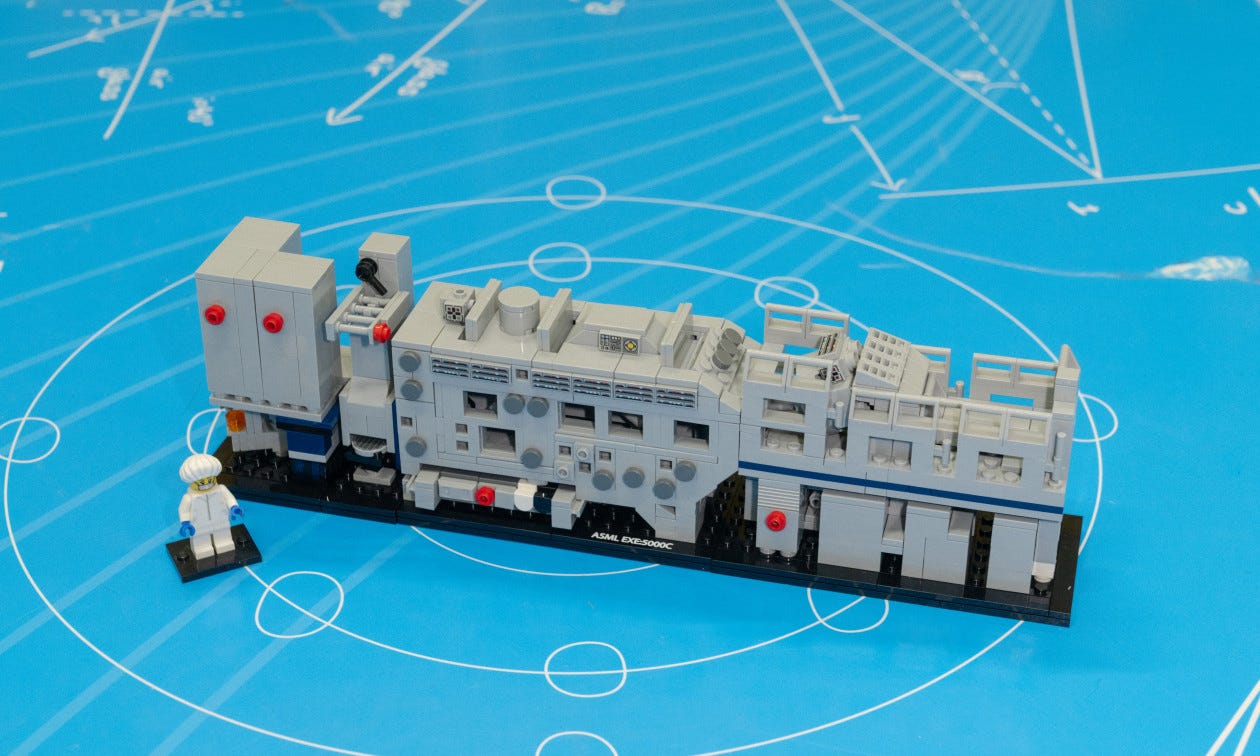
But right now, the most coveted product coming out of ASML is the 1,000-piece Lego version.
The project started with Rick Lenssen, a data analyst at ASML, with a hobby of designing custom Lego sets, and applied it to his day job. What began as a 25,000-brick replica of the company campus eventually turned into a mission to shrink the world’s most complex tool into a box of plastic bricks.
High-Tech Scarcity
The irony of the ASML Lego set is that it mimics the scarcity of the semiconductor industry itself:
Employee Only: You cannot buy these in stores. They are sold exclusively to ASML employees with a strictly enforced “one per person” rule.
Secondary Market Heat: Sets have surfaced on eBay for $600, with full collections reaching as high as $4,500.
The Sales Gap: To date, employees have bought 1,355 units of Lenssen’s latest Lego model (the EXE:5000C). In that same timeframe, ASML has sold only six of the real machines.
Why Does This Matter?
Beyond the novelty, there’s a deeper “human” layer here. Engineers often struggle to explain their hyper-complex (but meaningful) work to friends and families. Even though the world runs on it, and it involves high-powered lasers and mirrors polished to atomic-level precision . . . it’s hard to be a data analyst in an office and feel like your work is important.
The Lego set gives knowledge workers a bridge. It’s a way to take the $400 million “magic box” and turn it into something a child (or a spouse, or just about anyone) can touch, build, and understand.
Even at the absolute bleeding edge of human physics, we still have a fundamental desire to play.
A few folks from the HN (https://news.ycombinator.com/item?id=48007145) post have helpfully pointed out there may be two places where mere mortals can purchase this model:
Detailed instructions and a parts list can be found on ReBrickable, a non-official website that provides plans and links to parts: https://rebrickable.com/mocs/MOC-215601/NightHawk11991/asml-twinscan-exe5000/
AliExpress lists it as well, but the description is unclear if it's just the plans (in color?) or if it includes all the parts: https://www.aliexpress.us/item/3256810620790235.html